Liability in Tennessee Multi-Car Pileups
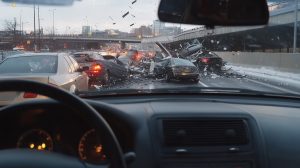 Multi-car pileups are some of the most dangerous crashes that take place on traffic-laden streets and highways, as these crashes often result in multiple injuries and extensive property damage. Beyond the dangers they pose, these crashes also raise complicated legal questions about who should be held accountable and to what extent. Here’s a quick look at how the state of Tennessee determines liability for multi-car crashes and an explanation of how our modified comparative negligence rule may impact your ability to recover compensation.
What causes multi-car accidents?
When picturing a run-of-the-mill car accident, most of us envision a collision between two cars or maybe even a single-vehicle crash. Some cases, however, involve several vehicles colliding with one another. These multi-car accidents are often referred to as “pileups” because they can leave multiple cars piled on top of or near one another.
Multi-car crashes tend to occur most often on crowded streets and in traffic jams where vehicles are more likely to be following one another at a close distance. In these environments, all it takes is one bad move to kickstart a domino effect that leaves a trail of destruction in its wake.
Some factors that may increase the likelihood of a multi-car pileup include:
- Dense or stop-and-go traffic
- Speeding
- Distracted driving
- Wet or icy road conditions
- Roadway hazards
- Unsafe lane changes
- Driving under the influence
- Drivers following too closely
- Poor visibility
In a general sense, it’s probably easy to understand how these factors and conditions can contribute to a multi-car accident. The real challenge, however, is establishing exactly how each of these factors influenced the development of a pileup and which parties should take the blame for their contributions.
Who is at fault for a multi-car crash?
Forget what you think you know about determining liability in car accidents. Multi-car pileups play by different rules. While many of us are accustomed to straightforward crashes where one party bears the brunt of the responsibility, multi-car crashes have way more variables to consider. Sorting through all the facts and details can be tedious, and divvying up fault requires careful investigation and skilled legal counsel.
When investigating a multi-car pileup, law enforcement agents, insurance companies, and car accident lawyers will look at all of the factors that might have influenced the outcome of a crash. While it might be tempting to assume that the person at the “front of the line” was solely responsible for the crash, these accident scenarios are seldom this black and white.
On the contrary, the first driver to hit their brakes or suddenly swerve out of their lane usually won’t be deemed 100% responsible by default. Rather, findings of fault in these cases require investigators to heavily scrutinize all the factors that contributed to a crash prior to making a judgment call about liability.
Examples of complex liability in multi-car accidents
It might be helpful to look at some case examples in order to get a better sense of the nuances associated with determining liability in multi-car crashes. Here are a few scenarios we’ve pulled together to demonstrate these concepts:
Scenario #1: Chain reaction
Let’s say John stops suddenly on a congested highway, and Steve rear-ends him. This subsequently triggers a chain reaction of rear-end collisions, leaving multiple vehicles damaged. Even though John technically “started” the domino effect by braking suddenly, Steve might bear some or all responsibility for the accident if an investigation determines that he was following John too closely and was therefore unable to stop in time to avoid a crash.
Scenario #2: Roadway hazard
Here’s another example: While driving down I-24, Susan suddenly swerves to avoid a box that has fallen off a cargo truck in front of her. In attempting to avoid this hazard, however, Susan accidentally sideswipes Jane. While it might be tempting to assign all of the blame to Susan for swerving into another lane of traffic, full or partial liability may actually lie with the truck driver or logistics company responsible for the poorly secured cargo.
Scenario #3: Traffic light malfunction
Finally, let’s say four drivers are passing through an intersection controlled by a four-way traffic signal that suddenly goes rogue and displays green lights in all four directions. As a result, all four drivers, each believing they have the right of way, collide with one another at high rates of speed. While there may be some room to argue that the drivers should have exercised greater care to avoid a collision, the bulk of the fault in this case may actually lie with the government agency or department responsible for maintaining the local stoplights.
While some of these scenarios may seem like extreme examples, they all highlight the many different directions these cases can take when it comes to determining fault. Between individual motorists, government entities, maintenance providers, and more, there’s no shortage of potential sources of liability in a multi-car crash.
Comparative negligence in Tennessee: How it works
To address some of the complexities of cases where multiple parties share liability for an accident, the state of Tennessee follows a modified comparative negligence system. Under this system, as long as you are found to be less than 50% at fault for the crash, you may be able to recover some amount of damages. But here’s the catch: Any damages you are owed will be reduced by a percentage commensurate with your level of fault for the accident.
For example, if you are involved in a multi-car pileup and the investigation reveals that you were 30% responsible for the crash, your final settlement or damage award will be reduced by 30%. If, however, you were 60% to blame, you would not be entitled to any damages under the law.
This system can be both a blessing and a curse. On the one hand, it makes it possible for you to recover compensation even if you contributed to the crash in some way. On the other hand, it makes it crucial for you and your lawyer to build a strong case for limited liability. The other parties involved in your accident are likely aware of the fact that they can get out of paying the full value of your claim if they can argue that you contributed to your own injuries in some way. Insurance companies and opposing counsel will run with this argument as far as you let them in order to minimize payouts and secure more favorable deals for their clients.
An experienced local car accident attorney can help you fight back against these efforts to short-change you by conducting a thorough investigation and gathering a wealth of evidence that supports your version of events. Your lawyer may also be able to enlist the help of accident reconstructionists and other expert witnesses who can back up your claims and convince insurers, judges, or juries that you are entitled to compensation.
Final thoughts
The stakes are high in multi-car pileups, as these accidents often cause extensive damage and serious injuries. In Tennessee, these accidents become even more complicated thanks to our comparative negligence system, so it’s ideal to work with a reliable and knowledgeable lawyer who can help you fight for the full amount of compensation you deserve.
At Wagner Workers Compensation & Personal Injury Lawyers, we believe that responsible parties should be held accountable for the physical, psychological, and financial harms they cause, even if that accountability lies with multiple people or entities. With decades of experience fighting for accident victims in Chattanooga and the surrounding areas, we understand how to build a strong case within the framework of Tennessee’s legal system.
If you or a loved one was involved in a multi-car accident in or around Chattanooga, don’t settle for less than you deserve. Contact our team online or by phone today to schedule a free consultation and discover why so many Tennesseans trust our team to fight for their rights in the wake of a complex motor vehicle accident.
Patrick has been with Wagner Workers Compensation & Personal Injury Lawyers as a practicing attorney since 2017. As an associate with the firm, Pat has been primarily focused on litigation. Learn More